The explosive birth of our cosmos may have roots far beyond our reality.
For decades, the Big Bang has been
described as the ultimate beginning—the moment when space, time, matter, and
energy came into existence.
But modern cosmology is increasingly uncomfortable with the idea that the
universe came from true “nothing.”
A growing number of scientists now ask a profound question:
What if our Big Bang was triggered by something happening in a different universe?
From cosmic collisions to quantum bubbles, new theories are opening doors to a multiverse where universes give birth to one another.
The Problem With the “Beginning From Nothing” Model
The classical Big Bang theory leaves major questions unanswered:
· Why was the early universe incredibly fine-tuned?
· Where did the inflationary field come from?
· Why does the cosmos contain so much order?
· How did quantum rules suddenly give way to classical physics?
These problems hint that something existed before the Big Bang, even if not in our spacetime.
This is where multiverse-based models step in.
1. The Cosmic Collision Hypothesis (Ekpyrotic Universe)
One of the boldest ideas comes from string theory.
In the ekpyrotic model, our universe exists on a “brane”—a multi-dimensional membrane floating inside a higher-dimensional space.
According to the theory:
· Another brane exists parallel to ours
· It collided with our brane
· The collision released enormous energy
· That energy became the Big Bang
In this scenario, the Big Bang is not creation—it’s an impact event.
The real action happened outside our universe.
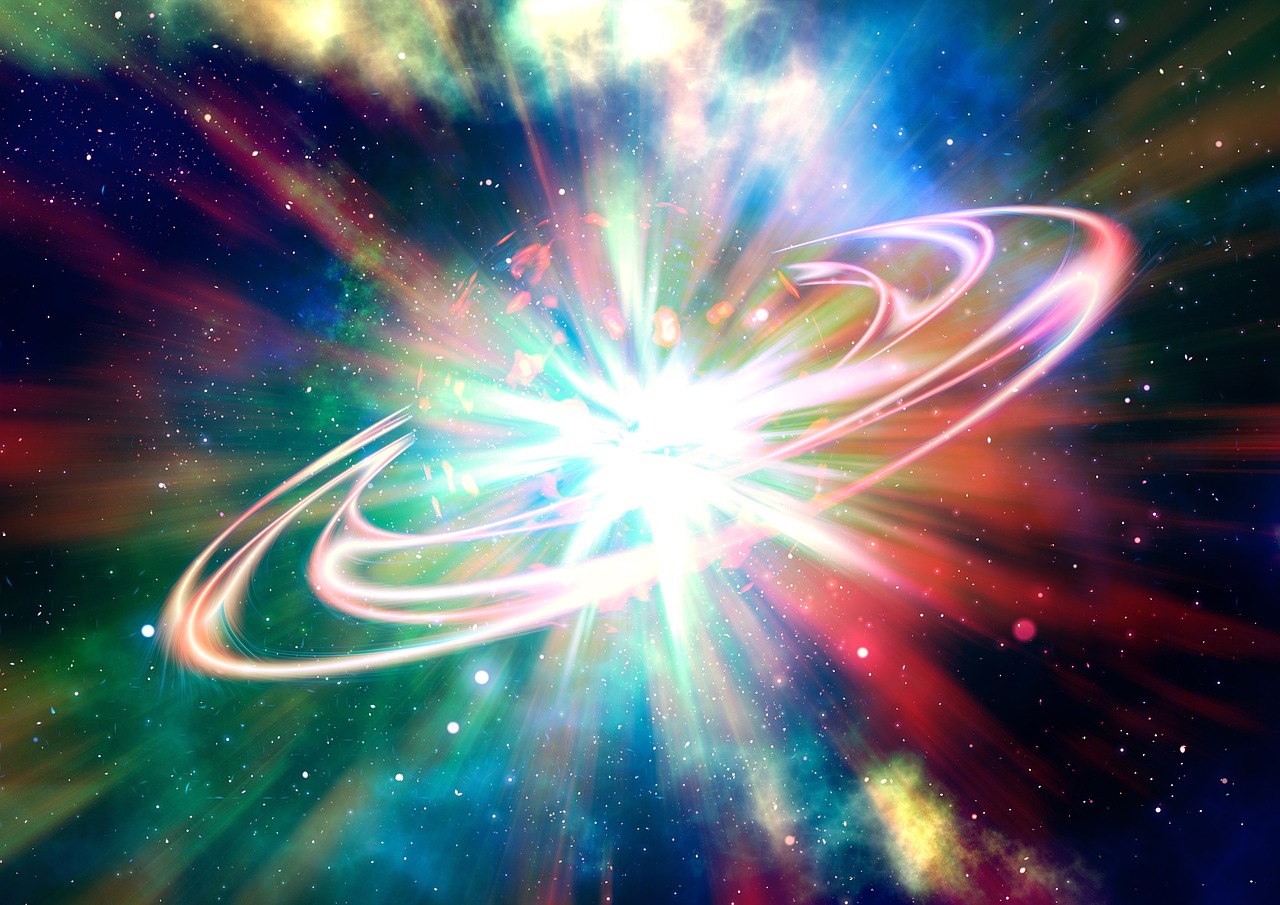 |
| Could the Big Bang Have Been Triggered by Another Universe? |
2. Eternal Inflation: Bubbles Colliding in a Cosmic Foam
Eternal inflation suggests the universe keeps expanding beyond our cosmic horizon, creating:
· Bubble universes
· Pocket universes
· Isolated regions with different physical laws
If two bubbles touch, the collision can:
· Trigger a massive release of energy
· Create hot, dense regions
· Generate a new universe phase
Our Big Bang could be the aftershock of such a bubble collision.
Some physicists even search the cosmic microwave background for “collision scars.”
3. Quantum Tunneling: A Universe Born Through a Cosmic Shortcut
Quantum physics allows particles to “tunnel” through barriers instantly.
Some theories propose that:
· A tiny region in another universe tunneled
· The tunneling created a new spacetime bubble
· That bubble expanded into our universe
· For the parent universe, it was microscopic
· For us, it became everything
This is similar to how black holes might create baby universes, escaping singularity via quantum effects.
4. The Black Hole Universe Hypothesis
What if our universe started inside a black hole inside another universe?
Some models suggest:
· Black hole cores don’t end in singularities
· Instead, they bounce into new expanding regions
· Each black hole births a new universe
· Our Big Bang could be the rebound of gravitational collapse
If so, every universe might be part of a cosmic “family tree.”
5. The Cyclic Universe: Endless Births and Deaths
Another possibility is that universes don’t truly begin or end—they recycle.
In cyclic models:
· The universe expands
· Expansion slows
· The universe collapses
· The collapse triggers a new Big Bang
But some advanced versions propose multiple
universes feeding the cycle.
A contracting universe in one realm may ignite a new expansion phase in
another.
Could We Detect Another Universe’s Influence?
Surprisingly, maybe yes.
Scientists look for:
· Cold spots in the cosmic microwave background
· Unusual patterns that break uniformity
· Signs of anisotropy
· Gravitational imprints with no known cause
· Regions with unexplained temperature dips
Some data hints at structures too large to fit inside a single Big Bang model.
These may be fingerprints of another universe interacting with ours.
Does This Mean We’re Not Alone in the Cosmos?
If any of these models are correct, then:
· The multiverse is real
· Universes can interact
· The Big Bang isn’t the beginning
· Our cosmos has a deeper history
· Reality extends far beyond what we can observe
It also means our universe may one day give birth to another, continuing the chain.
Final Thought
If the Big Bang was triggered by events in
another universe, then our reality is not an isolated miracle.
It is part of a vast, interconnected system of universes—each influencing the
next.
And perhaps the true origin story of our cosmos lies not within our time and space, but in the hidden dimensions beyond it.




0 Comments