The untold story of Henry Moseley — the physicist who decoded the periodic table, only to vanish from science too soon
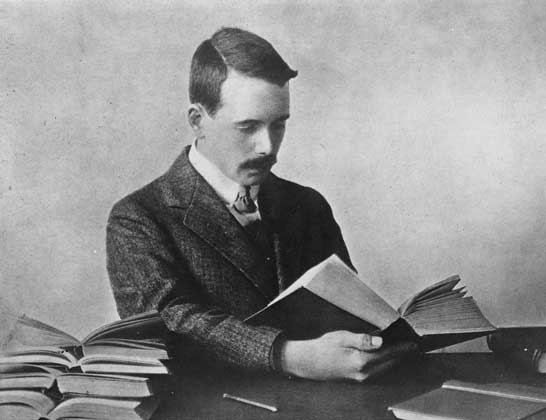 |
| Henry Moseley |
In the early 20th century, the world of physics was exploding with discovery. Einstein had reshaped time, Rutherford had split the atom, and Bohr was building his model of the universe. But among these titans stood a young, quiet genius whose brilliance could have changed science forever — Henry Gwyn Jeffreys Moseley.
He didn’t live to see the revolution he sparked, but his name remains whispered among scientists as the man who gave order to chaos — and whose loss changed the course of physics.
The Hidden Order Within Atoms
Before Moseley, the periodic table was arranged by atomic weight — a system that often failed. Elements like cobalt and nickel seemed misplaced, and no one knew why. In 1913, at just 25 years old, Moseley used X-ray spectroscopy to uncover a hidden law: each element’s identity is defined not by its weight, but by its atomic number — the charge of its nucleus.
This single discovery reshaped chemistry and physics. It gave structure to the periodic table, revealed missing elements yet to be discovered, and proved that atomic number — not mass — was the true fingerprint of matter.
Einstein called it “a fundamental leap in scientific understanding.”
A Mind Lost to War
But just as his brilliance was being recognized, the world plunged into darkness. When World War I erupted, Moseley enlisted in the British Army — not as a scientist, but as a soldier. In 1915, during the Battle of Gallipoli, a sniper’s bullet ended his life. He was only 27.
His death sent shockwaves through the scientific community. Many historians believe that had he lived, he might have been the next Rutherford — or even Einstein. The loss was so profound that after his death, Britain banned the enlistment of leading scientists in combat roles.
The Legacy That Still Resonates
Every atomic number you see on the periodic table — from hydrogen to oganesson — exists because of Moseley’s work. His Moseley’s Law remains a cornerstone of atomic physics, bridging the worlds of X-rays, quantum theory, and nuclear science.
Yet, outside laboratories and textbooks, his name faded into obscurity — a silent casualty of war and time.
The Man Who Defined Matter
Henry Moseley didn’t live long enough to witness his impact, but his equations still speak — the hidden rhythm of atoms he revealed continues to define the universe itself.
He wasn’t just a scientist; he was the one who measured the unseen — and, in doing so, changed everything.





0 Comments